- India Anaïs
- Guides
- Special-effect polish
- Colour changing nail polish: the microcapsule chemistry behind thermal lacquer
Colour changing nail polish: the microcapsule chemistry behind thermal lacquer

Colour changing nail polish contains microcapsules, 1 to 10 microns across, that hold a leuco dye, a weak acid and a solvent. Below the switch temperature the solvent is solid and the dye is coloured. Above it the solvent melts and the dye turns clear, revealing the pigment underneath. Tips change first because they are cooler than the nail bed.
Thermal nail polish is a lacquer whose colour depends on the temperature of the nail. Warm hands wear one shade. Cold air, cold water or a glass of iced water turn the tips, and sometimes the whole nail, to a second shade. The change reverses within seconds and repeats for the life of the manicure.
The trick is not in the pigment you can see. It is in a second, hidden colourant that switches on and off with heat. The chemistry is the same as in mood rings and colour-changing mugs, packed into capsules small enough to pass through a polish brush.
What is inside a thermal nail polish?
A thermal polish is an ordinary lacquer with thermochromic microcapsules added. The microcapsules are tiny spheres about 1 to 10 microns across, as chemist Michelle Wong explains in her Lab Muffin explainer on thermal polish. A micron is a thousandth of a millimetre, so the capsules are far smaller than a grain of glitter and invisible on the nail.
Each capsule holds three things. The first is a leuco dye, a coloured chemical that turns colourless when it picks up a hydrogen ion (H+). The second is a weak acid, a colourless chemical that competes with the dye for the same hydrogen ion. The third is a solvent with a melting point set at the temperature where the maker wants the colour to change.
The capsule wall keeps the three together and keeps the polish solvents out. That is why thermal pigment can be stirred into a normal nitrocellulose lacquer without losing its behaviour.
How does the leuco dye switch colour?
The switch is a competition for one hydrogen ion. When the solvent inside the capsule is solid, which happens when the nail is cold, the hydrogen ion stays attached to the weak acid. The dye keeps its own hydrogen-free form and shows its colour. When the nail warms and the solvent melts, the hydrogen ion moves to the dye instead. The dye becomes colourless, according to Lab Muffin.
The solvent's melting point is the thermostat. Its melting point is set around the temperature at which the maker wants the colour to change. Below that temperature the capsule is coloured; above it the capsule is clear. The reaction is reversible, so cooling the nail brings the colour straight back.
The most common leuco dyes are spirolactones and fluorans. A textbook example given on the thermochromism page of Wikipedia is crystal violet lactone with a weak acid in a solvent such as dodecanol. Commercial thermochromic formulations switch over a span of roughly 3 to 5 degrees Celsius, with set points from about 17 to 23 degrees Celsius up to 37 to 40 degrees Celsius.
Why does the nail show two colours?
Makers blend the leuco dye with a normal pigment. When the nail is warm, the leuco dye is transparent and you see only the base pigment. When the nail is cold, the coloured dye and the base pigment combine into a third, mixed shade. A polish with a lilac base and a purple leuco dye reads lilac when warm and deep plum when cold.
This is why the warm shade is always the lighter or cleaner of the two, and the cold shade the deeper or more mixed one. The leuco dye can only add colour, never remove it.
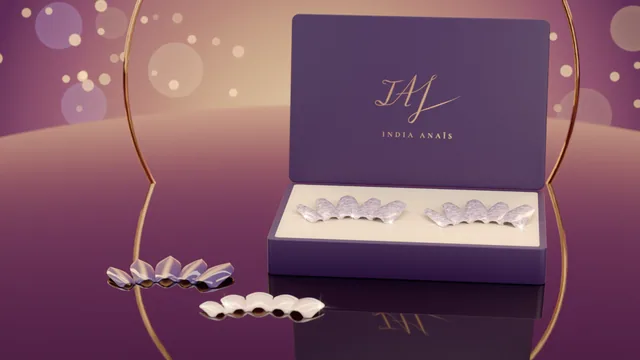
India Anaïs Twilight Shift is built this way: plum when warm and lilac at the cool tips. It is sold out with the first edition; the next edition is planned for spring 2027.
Why do the tips change before the rest of the nail?
The nail plate is warmed from underneath by the nail bed, which is full of blood vessels. The free edge, the part of the nail that extends past the fingertip, has no nail bed under it. It is cooled by the air on both sides. On most days the free edge is a few degrees cooler than the base of the nail, so it crosses the switch temperature first.
The result is a natural gradient, warm colour at the cuticle and cold colour at the tip, with a soft band between them. The band moves up and down the nail through the day as the room, the weather and the hands warm and cool. Long nails show a wider cold zone than short nails, because more of the plate hangs free of the finger.
Cold water, a cold drink, cycling in autumn air or a cold office turn the whole nail. A hot shower or a mug of tea turn the whole nail back. The polish never changes on its own; it only reports the temperature of the nail beneath it.
How long does the colour-changing effect last?
| Factor | Effect on the switch | What to do |
|---|---|---|
| Ultraviolet light (sun, tanning lamps) | Leuco dyes lose strength with prolonged UV exposure; users report thermal polish switching more weakly after weeks of summer sun | A top coat with a UV filter; wear gloves for long outdoor exposure if the effect matters |
| Heat above the set point for long periods | The dye spends most of its time clear; the switch itself is unharmed | None needed; the cold colour returns when the nail cools |
| Thick coats | More capsules, stronger cold colour, but a slower switch | Two thin coats; one for a subtle gradient |
| Top coat | Does not stop the switch; a thick glossy coat makes the gradient look deeper | Apply as normal; reapply every two to three days for wear |
| Age of the bottle | Capsules can settle; the polish looks paler until shaken | Roll the bottle between the hands before use |
The switch itself does not wear out within the life of a manicure. Thermal lacquer wears like any other regular polish, about 3 to 7 days depending on prep and top coat, the range reported in a luxury-polish comparison by Who What Wear. The effect fades over months in the bottle and over weeks of strong sun on the nail. On liquid-crystal thermochromics, the Wikipedia page notes that high temperatures, ultraviolet radiation and some solvents shorten lifespan; leuco dyes are more forgiving but not immune.
How do you apply thermal polish for the best gradient?
You will need:
- A base coat
- A thermal lacquer, rolled between the hands to lift the capsules
- A glossy top coat
- A bowl of cold water for testing
- Prep the nail as for any manicure: push back the cuticle, buff lightly, wipe with alcohol.
- Apply one thin coat of base coat and let it set.
- Apply a first thin coat of thermal lacquer. Cap the free edge so the tip, where the colour change shows most, is sealed.
- Wait one to two minutes and apply a second thin coat. Two thin coats give a cleaner switch than one thick coat.
- Let the colour dry for five minutes, then seal with top coat.
- Test after an hour by dipping one hand in cold water for ten seconds. The tips should turn first, then the whole nail.
Thermal pigment behaves the same over light and dark bases, because the capsules sit inside the coloured lacquer, not on top of it. Pick the shade by its warm colour, since that is what the nail shows for most of the day indoors.
“When the solvent is solid (cold), the H+ prefers to stick to the weak acid (coloured dye), whereas when the solvent is liquid (hot), the H+ prefers to stick to the dye (colourless dye)”
Michelle Wong, Chemist and science educator, Lab Muffin Beauty Science
- Thermal polish switches colour with leuco dye microcapsules, 1 to 10 microns across, that hold a dye, a weak acid and a solvent with a set melting point.
- Cold keeps the solvent solid and the dye coloured; warmth melts the solvent and moves a hydrogen ion onto the dye, which turns clear.
- The warm shade is the base pigment alone; the cold shade is the base pigment plus the dye, so the cold colour is always deeper.
- Tips change first because the free edge has no warm nail bed under it.
- The switch outlasts the manicure; strong ultraviolet light and old, unshaken bottles weaken it over time.
Questions people ask
How does colour changing nail polish work?
It contains microcapsules holding a leuco dye, a weak acid and a solvent that melts at the switch temperature. Cold keeps the dye coloured. Warmth melts the solvent, a hydrogen ion moves onto the dye and it turns clear, so only the base pigment shows.
Why do only the tips of my thermal nails change colour?
The free edge has no nail bed underneath, so it is cooler than the rest of the nail. It crosses the switch temperature first. Dip the hand in cold water and the whole nail will change; in a warm room, only the tip does.
At what temperature does thermal nail polish change?
It depends on the solvent the maker chose. Commercial thermochromic pigments switch over a span of about 3 to 5 degrees Celsius, with set points anywhere from around 17 degrees to body temperature. Nail polish makers aim for a point between room and skin temperature so the tips show a gradient.
Does thermal polish stop working?
The switch does not wear out within a manicure. Over weeks of strong sun the leuco dye can weaken, and an old bottle whose capsules have settled looks pale until rolled. Store it away from sunlight and roll before use.
Can you put top coat over thermal nail polish?
Yes. A top coat does not block the temperature change, because the capsules respond to the warmth of the nail, not the air. A glossy top coat makes the gradient look deeper and adds days of wear.
Sources
- How do thermal polishes work? · Lab Muffin Beauty Science, 2013
- Thermochromism · Wikipedia
- The 8 Best Luxury Nail Polish Brands for Designer Nails · Who What Wear, 2022
- Nail Anatomy · Medscape, 2013


