- India Anaïs
- Guides
- Ingredients and safety
- Fragrance in nail polish: the solvent smell and the scented kind
Fragrance in nail polish: the solvent smell and the scented kind

The smell of nail polish is its solvents. Ethyl acetate and butyl acetate evaporate as the film dries and have a sweet, fruity, pear-drop odour. Scented nail polish adds a fragrance that is released once the film is dry. In the EU any perfume appears as parfum on the ingredient list, and named fragrance allergens must be listed when they exceed 0.001 percent in a leave-on product.
Two smells belong to nail polish. The first is the sharp, fruity smell that fills a room while the polish dries and is gone within the hour. The second is rarer: a perfume that some polishes and most cuticle oils are made to give off after they have set.
Where each smell comes from, how scented polish works, how the EU requires perfume and its allergens to be labelled, and how to paint your nails with less solvent in the air, with the chemistry and the regulation text behind each point.
Why does nail polish smell the way it does?
Nail polish is nitrocellulose, resins and plasticisers dissolved in volatile solvents, mainly butyl acetate and ethyl acetate. The polish dries because the solvents leave the film and enter the air, and what enters the air is what you smell7. The smell is the drying process made audible to the nose.
Ethyl acetate has a characteristic sweet smell similar to pear drops and boils at 77 °C, which is why it evaporates so readily at room temperature. It occurs naturally in fruit and is the most common ester in wine1. Butyl acetate, the larger molecule, evaporates more slowly and gives the film time to level before it sets. Together they are the polish smell, and together they are gone once the film is hard.
Nail polish remover smells of the same family, with acetone or ethyl acetate as the solvent9. Acetone is sharper and evaporates faster still, which is why a remover-soaked pad announces itself across a room.
What is scented nail polish and how does it work?
Scented nail polish is a lacquer with a fragrance oil added to the formula, made so that the perfume is noticeable after the solvents have evaporated and the film has set. While the polish is wet the solvent dominates. Once it is dry, the fragrance molecules held in the film evaporate slowly from its surface, in the same way that a scented candle gives off perfume from wax.
The best-known example was Revlon's Parfumerie collection, launched in March 2014 with 24 scented shades at a suggested price of $5.99, marketed on the promise that when the enamel dries it gives a light fragrance meant to last all day2. In practice the perfume from a film a few hundredths of a millimetre thick is faint and fades over a day or two, faster under a top coat that seals the surface.
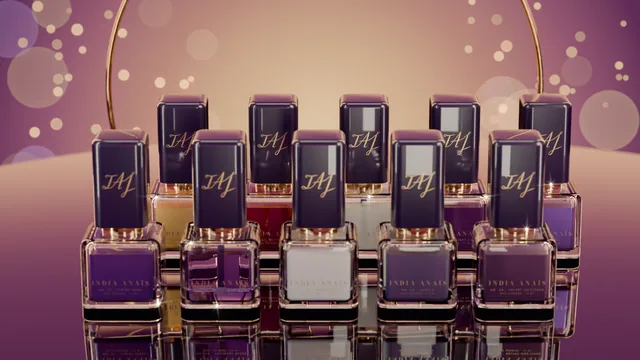
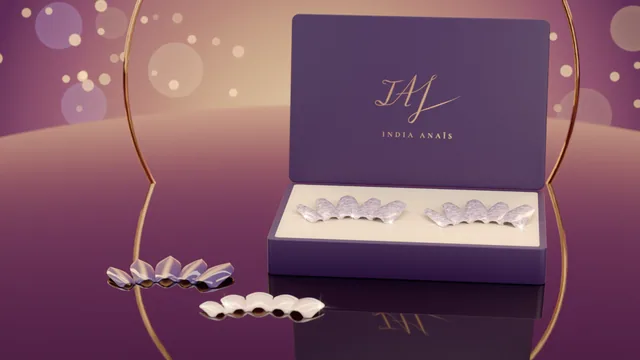
Luxury houses tend to put fragrance in the hand care around the polish, where there is more product for it. Hermès had its in-house perfumer Christine Nagel design the scent of the hand cream in its Les Mains collection8. India Anaïs follows the same logic: the lacquers are unscented beyond their solvents, and the Gold Drop cuticle oil has a soft amethyst scent. The first edition is sold out and the next edition is planned for spring 2027.
How is fragrance labelled on a nail polish in the EU?
The EU Cosmetics Regulation (EC) 1223/2009 requires perfume and aromatic compositions and their raw materials to be referred to by the terms parfum or aroma in the ingredient list3. A single word covers a blend that may contain dozens of materials.
The exception is the list of recognised fragrance allergens, which must be named individually when they exceed a threshold: 0.001 percent in a leave-on product such as nail polish or cuticle oil, and 0.01 percent in a rinse-off product. Until 2023 the list held 26 substances. Commission Regulation (EU) 2023/1545 added 56 more, to a total of 82. Products placed on the EU market from 31 July 2026 must show the extended labelling, and products already on the market may be sold through until 31 July 20284.
| Rule | Until 30 July 2026 | From 31 July 2026 |
|---|---|---|
| Number of named allergens | 26 | 82 |
| Threshold, leave-on (polish, oil, cream) | 0.001 percent | 0.001 percent |
| Threshold, rinse-off (hand wash) | 0.01 percent | 0.01 percent |
| Sell-through of old labels | Not applicable | Until 31 July 2028 |
| Examples added in 2023 | Limonene, linalool, citral, geraniol, coumarin already listed | Vanillin, menthol, carvone, the rose ketones, salicylaldehyde, turpentine, Peru balsam |
The examples come from the regulation's own list as summarised by Registrar Corp5. For a reader, the practical effect is that a scented polish or cuticle oil sold in Europe names the allergens it contains right after parfum, and an unscented one shows neither.
Which fragrance allergens matter if you have sensitive skin?
Fragrance allergy is a contact allergy: the skin reacts where the perfume touches it, with redness, itching and sometimes small blisters. On a manicure the contact points are the cuticle, the nail folds and anywhere the hands are rested against the face. A scented cuticle oil applied twice a day puts more fragrance on skin than a scented polish does, because the oil is designed to spread and stay.
The names to know are the ones on the EU list. Limonene and linalool are in almost every citrus or floral blend and are listed after parfum whenever they pass the threshold. Geraniol, citral, citronellol and coumarin are common in rose, lemon and hay-type scents. Among the 56 added in 2023, vanillin and menthol are the two most people will recognise5.
A person with a known fragrance allergy confirmed by patch test can use the ingredient list as a filter: no parfum, no named allergen, no problem from that source. A person with unexplained dermatitis around the nails should see a GP or dermatologist, because fragrance is only one of several possible causes, alongside the tosylamide resin in some lacquers and the methacrylates in gel10.
How to paint your nails with less solvent in the air
You will need: a room with a window, a base coat, your colour, a top coat, a small dish or lid to rest the brush on, and a bin with a lid for cotton pads.
- Open the window before you open the bottle. The smell is solvent leaving the film, and moving air takes it out of the room before you breathe it.
- Cap the bottle between coats. An open bottle evaporates the whole time it stands, which thickens the polish and adds to the smell.
- Paint thin coats. Regular polish is touch-dry in about 3 to 5 minutes; a thin coat releases its solvent in that window and is done11.
- Put used remover pads straight into a closed bin. A pad on the table keeps releasing acetone until it is dry.
- Keep polish and remover away from candles and hobs. The solvents are flammable, which is the other reason waste authorities ask for care in disposal.
- Leave the room for a few minutes once the top coat is on, and let the air clear.
Does a strong smell mean a polish is unsafe?
Smell tracks volatility, not toxicity. A polish smells strongly because its solvents evaporate quickly, which is also what makes it dry quickly. A slow-drying polish smells less at any one moment and for longer. Neither fact says anything about which solvents are in the bottle.
The solvent that raised the most concern historically, toluene, is limited in the EU to 25 percent in nail products and must be labelled to be used by adults only and kept out of reach of children6. Most modern polishes use no toluene and rely on the acetates, and they smell just as strongly of pear drops. A polish that is 3-free, 5-free or 10-free smells of solvent like any other, because the acetates are on none of those lists10.
Water-based polish is the one type that smells little, because its film former is an acrylic emulsion in water and its solvent load is small. The trade is drying time: water-based polish dries more slowly and is harder to remove7. For anyone who finds the solvent smell unpleasant, ventilation is the answer that costs nothing and changes nothing about the manicure.
- The polish smell is ethyl acetate and butyl acetate evaporating from the film, and it ends when the film is dry.
- Scented polish holds a fragrance oil in the film that evaporates slowly after the solvent has gone; the effect is faint and short-lived.
- In the EU, perfume is listed as parfum, and named allergens must appear above 0.001 percent in a leave-on product.
- The allergen list grows from 26 to 82 substances for products placed on the market from 31 July 2026, with sell-through to 31 July 2028.
- A strong smell means fast evaporation, not danger; an open window is the fix.
Questions people ask
What makes nail polish smell?
The solvents, mainly ethyl acetate and butyl acetate. They evaporate as the polish dries and have a sweet, fruity, pear-drop odour. Once the film is hard, the smell is gone.
Is scented nail polish safe?
It is regulated like any other cosmetic. In the EU the perfume must be listed as parfum and any recognised allergen above 0.001 percent must be named. People with a fragrance allergy should choose unscented polish and oils and check for named allergens.
What does parfum mean on an ingredient list?
Parfum, or aroma, is the word EU law requires for a perfume or aromatic composition and its raw materials. It can stand for a blend of many substances. Recognised fragrance allergens above the threshold are listed separately by name.
Why does nail polish remover smell so strong?
Most removers are acetone or ethyl acetate, both of which evaporate faster than the solvents in polish. Keep the bottle capped, put used pads in a closed bin and open a window.
Is the smell of nail polish harmful?
In a ventilated room the amount of solvent breathed during one manicure is small. The studies that raise questions concern salon workers exposed for hours every day. Open a window, cap the bottle between coats and paint thin coats.
Sources
- Ethyl acetate · Wikipedia
- Revlon's Parfumerie collection brings fragrance to nails · Drug Store News, 2014
- Regulation (EC) No 1223/2009, Article 19 (labelling) · legislation.gov.uk
- Fragrance allergens July EU deadline: FAQ · COSlaw.eu, 2026
- EU Fragrance Allergen Expansion: the July 31, 2026 deadline · Registrar Corp, 2026
- Commission Directive 2009/6/EC · legislation.gov.uk, 2009
- Water-based nail polish innovation · Personal Care Magazine, 2012
- Hermès launches first nail polish and hand care collection · Wallpaper*, 2021
- Is acetone nail polish remover bad for your nails? · Sinclair Dermatology, 2019
- Clean Nail Polish: What 10-Free Actually Means and Why It Matters · Label Lookout, 2026
- Hoelang moet nagellak drogen? · Nagelstudios.nl, 2021